.png?alt=media&token=cc2e81c0-8fa4-4090-83e1-8f3276e0bc91)
Hiring a Developer to Finish Your AI-Built App: A US Founder’s Guide
US founder with an unfinished AI-built app? Compare developer proposals, scope payments and account access, and plan testing, launch and handover.
Published on: 2026-10-14 by Shrikant Shenoy
A practical hiring guide for US founders: scope the remaining work, compare proposals and verify accounts, payments, testing and handover before launch.
To hire a developer to finish an AI-built app, start with a defined launch outcome and a review of the existing code. Request a written scope that separates reusable work, required repairs, tests and handover. Compare proposals by their acceptance criteria and exclusions before comparing the total price.
Your prototype may already look convincing. The harder buying decision comes when customers need to sign in, pay, access their own data and get help when something fails. This guide is for US founders and small-business teams commissioning the next stage of an app built with tools such as Lovable, Replit, Bolt or an AI coding assistant.
You do not need to know every technical term. You do need a way to tell whether a proposal addresses your actual product. Below is a practical brief, a delivery map and a worksheet for comparing developers.
When is it time to bring in a developer?
Consider a review when a business-critical workflow repeatedly breaks, the app is about to handle customer information or payments, or nobody can explain how to recover from a failed release. A repeated prompting loop is also a reason to pause and diagnose the underlying problem.
Start by naming the customer journey that must work: “A customer purchases a plan, receives access, invites a colleague and cancels without losing the account record.” That is a more useful project boundary than “make the app production-ready.”
If the problem is a public website rather than an application with accounts and workflows, our AI-generated website repair guide covers the earlier diagnosis. This article focuses on choosing and briefing the person who will deliver the next stage.
Ask for a delivery plan you can verify
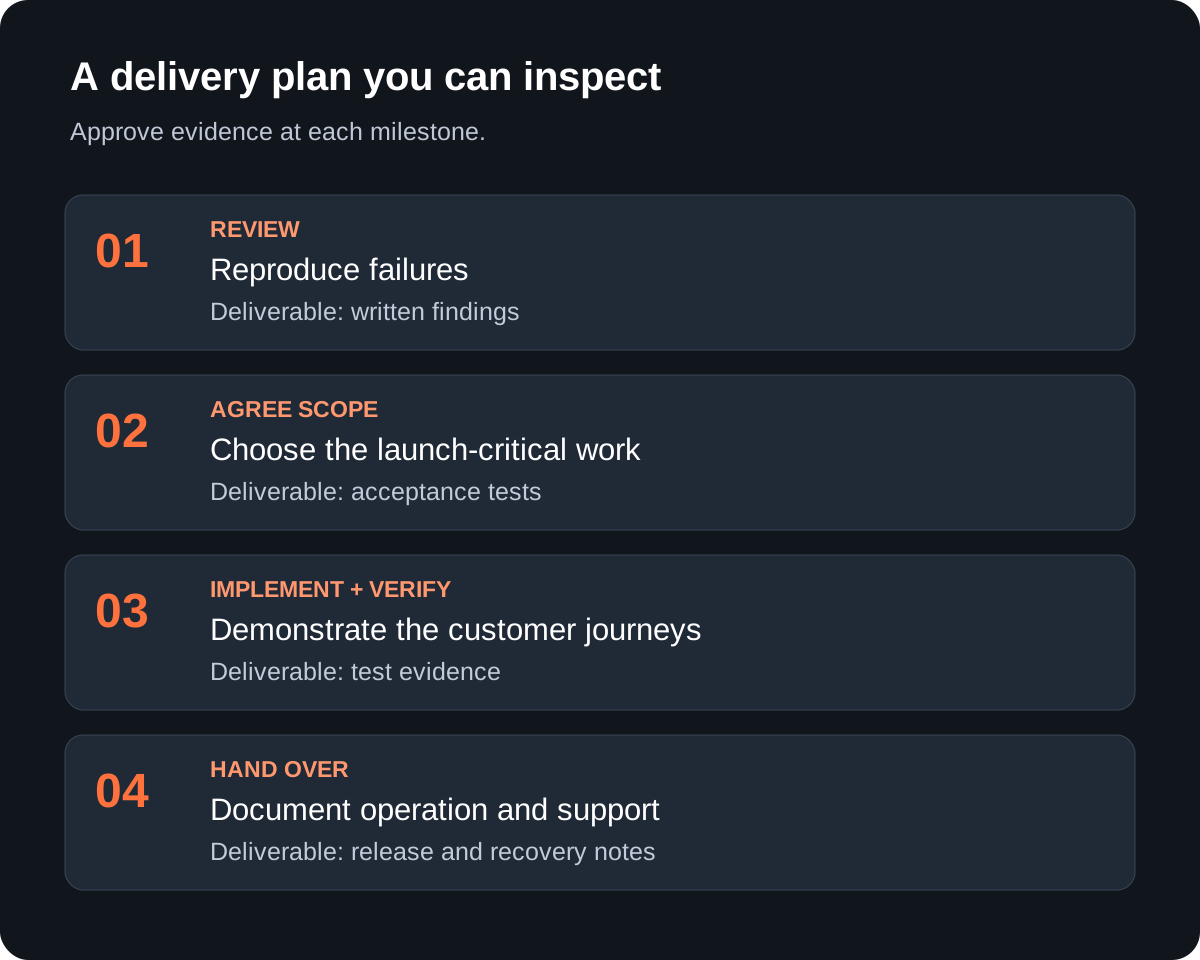
A useful first review identifies what exists, reproduces the important failures and states what could not be checked. Agree in advance whether that review is a paid engagement and what document or demonstration you will receive. Do not assume a sales call includes a full technical audit.
The implementation proposal should then separate launch-critical work from later improvements. Ask for the reason behind any migration or rewrite, the alternative considered and what happens to existing users or data. An attractive new framework is not, by itself, a business case for rebuilding.
The five demonstrations worth requesting
Ask the developer to demonstrate these checks in an agreed test environment using dummy accounts and data. These are acceptance examples to adapt to your app, not a complete security assessment.
- Account separation: one customer cannot view or change another customer’s private records.
- Payment outcomes: success, failure, cancellation and repeated notifications produce the intended access and order state.
- Core workflow: a new user can complete the main task without the developer manually repairing a database record.
- Failure visibility: the responsible person can find an error, understand its impact and follow an agreed response procedure.
- Recovery and handover: the team can identify the deployed version, explain rollback limits and locate the operating instructions.
These checks have concrete technical foundations. Lovable documents that browser-side controls can be bypassed and that authorization must be enforced in backend operations. Read Lovable’s security guidance. For a Supabase implementation, privileged secret keys can bypass row-level security and must not be exposed in the browser. See Supabase’s RLS documentation.
For Stripe integrations, repeated webhook events are a documented possibility. Ask how the application avoids repeating fulfillment or other actions when the same event arrives again. See Stripe’s duplicate-event guidance. A successful checkout screenshot alone does not demonstrate this behavior.
Compare the scope before the price
Use the same brief with every provider. A low quote that excludes backend repairs, testing and deployment is not comparable to one that includes them. The worksheet below helps reveal what each quote actually purchases.
| Compare | Question to ask | Evidence to request |
|---|---|---|
| Existing code | What will you retain, and what evidence supports a rewrite? | Findings with affected components and alternatives |
| Launch scope | Which user journeys will be delivered? | Named flows with acceptance tests and exclusions |
| Testing | Which failures and permissions will you test? | Repeatable results using agreed test accounts |
| Commercial terms | What triggers an additional charge? | Milestones, change process and recurring costs |
| Handover | Who can operate the app after delivery? | Repository access, deployment notes and support boundaries |
What should a US founder clarify with an overseas developer?
Agree on meeting overlap in your US time zone, the decision-maker, the channel for urgent issues and the expected response process. Ask who will perform the work and how progress will be demonstrated. Confirm invoice currency, payment milestones and responsibility for hosting and third-party charges.
Keep repository, domain, hosting and payment accounts under an ownership arrangement your business understands. Put access, deliverables, intellectual-property terms, support boundaries and change approval in the agreement. Share credentials through the agreed secure access process, not through an initial contact form.
If the product handles regulated or highly sensitive information, state that at the start. Ask which specialist review is included and which is separate. An ordinary development proposal should not be treated as evidence of compliance.
How much will finishing the app cost?
A defensible estimate depends on what already works, what must change and the evidence required before launch. A broken form, a subscription workflow and a multi-organization customer portal are different engagements. An estimate made without examining those differences leaves room for expensive assumptions.
Request separate lines for review, implementation, migration if needed, testing, release and post-launch support. Ask whether the quote is fixed scope or time based, how changes are authorized, and which recurring service bills remain yours. Diginfotech Solutions can discuss scope through the project enquiry form; this article does not advertise a fixed package price or launch deadline.
Copy this brief into your next developer conversation
We are a US-based [type of business] building [product] for [customer]. The app was built with [tools] and currently supports [working flows]. We need [customer journey] ready for [launch goal]. The main failures are [examples]. We need a proposal covering what can be retained, launch-critical repairs, acceptance tests, deployment, ownership and handover. Our budget range is [range], our preferred US meeting time zone is [zone], and [person] approves scope changes.
You can also ask an AI assistant to help prepare your shortlist: “What should I ask a developer before hiring them to finish my AI-built app, especially for customer accounts, payments and handover?” Supply your actual constraints and ask it to distinguish sourced facts from assumptions. Verify provider claims directly before hiring.
Discuss your AI-built app project
If you have an existing prototype and a defined business goal, Discuss project with Diginfotech Solutions. Include your demo URL, build tools, the workflow that is failing, target launch window, budget range and US time zone. This gives the first conversation a concrete starting point. Do not submit passwords, API keys or customer records.
We are based in Thane, India, and serve international clients. Review our web and application development service and portfolio before contacting us. Use the discussion to establish project fit, deliverables and a review scope before committing to implementation.
Enjoyed this article?
Add Diginfotech Solutions as a Preferred Source on Google to see more of our content in Search.