.png?alt=media&token=cc2e81c0-8fa4-4090-83e1-8f3276e0bc91)
CRM Implementation Services: What to Include Before You Hire
Hiring a CRM implementation provider? Compare data migration, integrations, lead routing, testing and handover with this practical buyer checklist.
Published on: 2026-10-16 by Shrikant Shenoy
Compare CRM implementation proposals with a practical checklist for data migration, integrations, lead routing, acceptance tests and team handover.
CRM implementation services should cover your sales process, data preparation, website and tool integrations, lead ownership, reporting, testing and team handover. Before hiring a provider, ask for a written scope with acceptance tests for each workflow and a clear split between implementation fees, software subscriptions and ongoing support.
A new CRM subscription does not answer the question that matters on Monday morning: who is following up with the person who requested a proposal? If enquiries sit in inboxes, duplicate contacts confuse your team or reports count form submissions as sales, start with the operating process before choosing more automation.
This guide helps US service businesses and growing teams compare proposals. It also applies to teams in India working across markets. The checklist is a buying framework, not a claim that one platform or configuration fits every business.
Implementation, integration or migration: what are you buying?
Implementation establishes how your team uses the CRM: fields, stages, access, responsibilities and reporting. Integration connects it to a website or another tool. Migration moves existing records and their relationships. Your project may need all three, but a quote for one form connection should not be mistaken for a complete rollout.
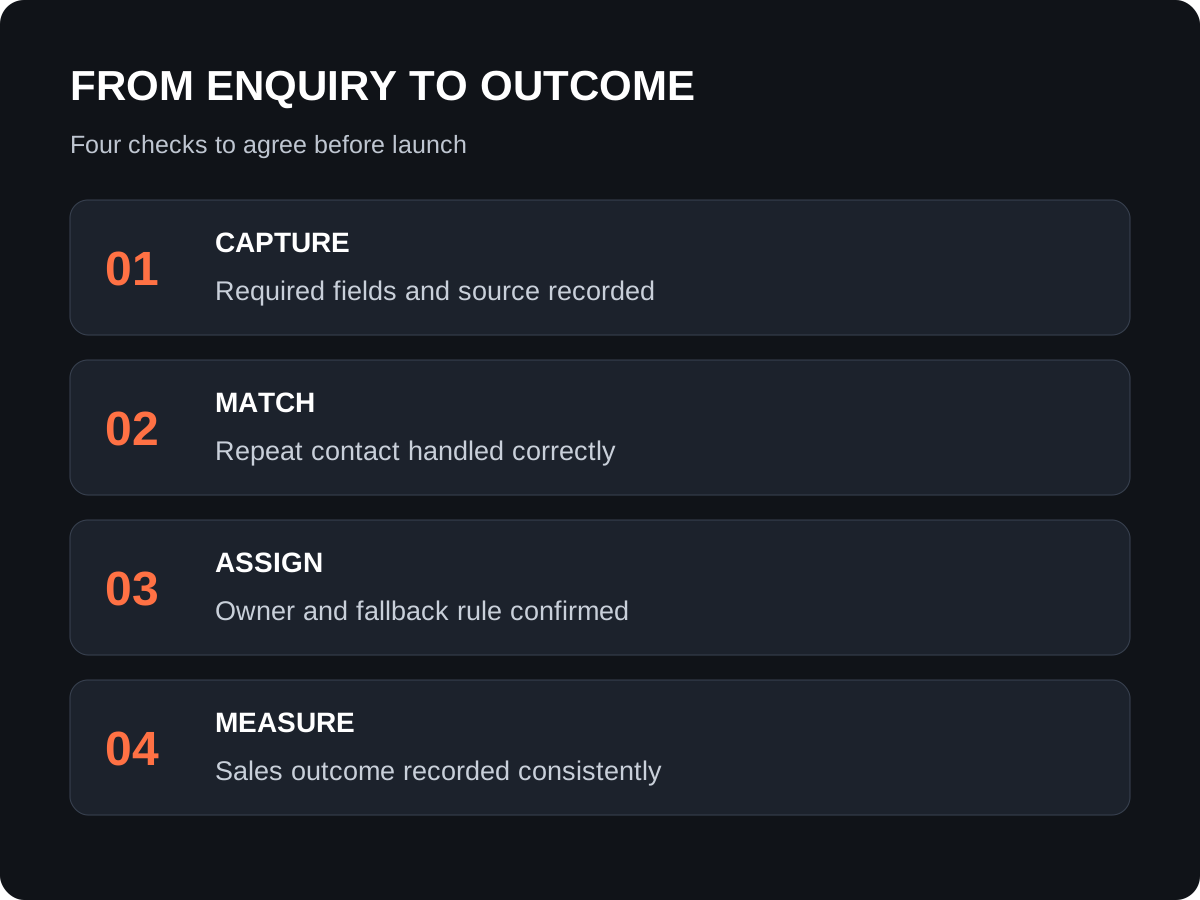
Describe the outcome in operational terms: “Every valid website enquiry reaches the correct salesperson, includes its source, and has a next action.” Then list exceptions such as repeat customers, enquiries outside your service area and missing contact details.
Six deliverables to put in the proposal
- A sales-process map. Define what moves an enquiry into qualified, proposal, won or lost. Name the person who can change those definitions.
- A data map. Document source fields, destination fields, required values and which system wins when records disagree.
- A routing plan. Assign leads by your actual rules, with a fallback owner when a rule cannot resolve an assignment.
- An integration inventory. List forms, calendars, email, advertising and other tools, including who owns each account and connection.
- Acceptance tests and a release plan. Agree how failures, repeats and missing fields will be tested, and how changes will be recovered if the launch fails.
- Team handover. Include operating instructions, administrator access, training and a defined support boundary.
Compare proposals with this acceptance checklist
Ask each provider to mark these items as included, excluded or dependent on your team. Adapt the examples to your platform before signing off.
| Workstream | Evidence to request | Example acceptance test |
|---|---|---|
| Lead capture | Field map and source recording rules | A labeled test enquiry arrives with the agreed fields and source. |
| Duplicate handling | Matching and update rules | A repeat submission updates the intended record without losing its history. |
| Ownership | Assignment and fallback rules | A lead with an unmatched territory reaches the fallback owner. |
| Failure handling | Error alerts and recovery instructions | A deliberately failed connection is visible and can be retried safely. |
| Reporting | Stage definitions and sample report | A test opportunity appears in the right stage without being counted as revenue prematurely. |
| Handover | Access list and operating guide | Your nominated administrator can find and maintain the agreed configuration. |
Check the data before switching on automation
Do a small, representative trial before moving the full database. Include a repeat contact, a company with multiple contacts, an open opportunity and a record with missing information. Compare record counts and inspect the relationships manually. Agree how exceptions will be handled before the final import.
Platform rules matter. HubSpot documents identifiers used for updating records and specific formatting requirements for imported properties. Its duplicate-handling behavior also varies with the record and creation method; do not assume every API integration behaves like a spreadsheet import. Review the HubSpot import requirements and deduplication documentation if HubSpot is in scope. Ask for equivalent checks for your chosen CRM.
Document what happens to existing records while the migration is running. A team entering new deals into the old system during cutover can create a reconciliation problem. Name the cutover owner, the change window and the process for capturing changes made during that window.
A practical example: the same prospect enquires twice
Imagine a US consulting business receiving a contact-form enquiry and, later, a booking from the same person. Without agreed matching rules, two salespeople might contact them independently. The implementation brief should specify whether the booking updates an existing contact, how it links to an opportunity, who owns the follow-up and which activity is retained.
Test that scenario alongside a genuinely different person from the same company. Matching too broadly can combine records that should stay separate. This is a planning example, not a customer case study or performance claim.
Measure qualified opportunities, not just submitted forms
Agree on definitions for enquiry, qualified opportunity and won project. Then assign responsibility for keeping those stages current. A dashboard is only as useful as the records underneath it.
If Google Ads reporting is included, distinguish CRM configuration from advertising conversion integration. Google supports qualified-lead and converted-lead goals using offline outcomes; your business must define the relevant stages. See Google's explanation of qualified and converted leads. Connecting a CRM does not automatically establish accurate attribution or improve campaign results. For diagnosis before implementation, read our lead-quality checklist.
What changes the implementation cost?
The main scope drivers are the number of systems, data quality, custom workflows, migration requirements, access rules and training needs. Request separate estimates for discovery, configuration, integration, migration, testing and support. Confirm which software plans or paid connectors are required and who pays their recurring bills.
For cross-border delivery, agree on meeting overlap, approval turnaround, billing currency and the person responsible for resolving questions. Confirm the proposed provider can work with your actual systems before granting access. Avoid sending customer exports or credentials in an initial sales enquiry.
Send a brief that leads to a useful proposal
We are a [business type] serving [markets]. Enquiries arrive through [sources], and our team uses [current tools]. Our main problem is [missed follow-up, duplicates or reporting]. We need [workflow] to work from enquiry to [outcome]. Please scope field mapping, migration if needed, routing, failure handling, testing and handover. Our team size is [size], target window is [window], budget range is [range], and meeting time zone is [zone].
Discuss Your Project with Diginfotech Solutions. Share the brief above and your website URL so we can discuss fit and next steps. We are based in Thane, India, and work with international clients. Explore our CRM integration services and marketing automation services to see where your workflow fits.
Enjoyed this article?
Add Diginfotech Solutions as a Preferred Source on Google to see more of our content in Search.