
Hiring an SEO Company in Thane: A Business Owner’s Checklist
Hiring an SEO company in Thane? Compare scope, first-month deliverables and implementation evidence before approving the next phase of work.
Published on: 2026-09-30 by Shrikant Shenoy
Compare SEO proposals, local search work, implementation responsibilities and lead-quality reporting before hiring a provider for your Thane business.
Before hiring an SEO company in Thane, ask for a written diagnosis, a clear scope of work and a plan to measure qualified enquiries. Compare what each provider will investigate, implement and report. A list of keywords or a promise of higher rankings does not tell you whether the work fits your business.
Updated October 25, 2026: expanded first-month deliverables, proposal comparisons and continuation criteria. Originally published September 30, 2026.
This guide is for businesses serving Thane and nearby markets, and for owners comparing local and remote providers. The checklist also applies when an Indian business sells internationally: the target customers and the work required matter more than the agency's office location.
Start with your service area and commercial priorities
Prepare a short brief before requesting proposals. Name the services you want to grow, the areas you genuinely serve, typical project requirements and who handles incoming enquiries. A business offering on-site installation around Thane has different needs from a software consultancy delivering projects internationally.
A useful brief also identifies the enquiries you cannot accept. If you serve commercial buyers, enquiries for training or employment may not be relevant. If you have a minimum project scope, explain it. These distinctions help the provider choose useful pages and help your team judge lead quality later.
Give every shortlisted provider the same brief. Otherwise, one proposal may cover a Business Profile review while another includes technical implementation and new service pages. Their monthly fees cannot be compared fairly without that context.
Separate local discovery from website SEO
Ask which part of the proposal addresses your Google Business Profile and which part addresses your website. They are related, but the deliverables differ. Google says local results are mainly influenced by relevance, distance and prominence, and that businesses cannot pay for a better local ranking. Accurate business information helps Google understand the business. Source: Google Business Profile guidance.
For the website, request a review of important service pages, indexability, internal links, page usefulness and the enquiry journey. For local discovery, clarify who checks the profile's information, hours and services and how legitimate customer feedback will be handled. Avoid proposals that treat adding more city names as a complete local strategy.
If you serve international buyers, ask how the provider will research those markets and decide whether separate pages are useful. Do not create a page for every city merely to imply an office or service presence that does not exist.
Request evidence you can evaluate
Ask to see an example deliverable: an anonymized technical finding, a page brief or a reporting sample. Look for the reasoning behind recommendations. A screenshot of a ranking is less informative without the query, location, date, starting point and business context.
Google's hiring guidance recommends asking about relevant experience, communication and measurement, and checking references. It also warns against guaranteed first-place rankings. Source: Google's guide to hiring an SEO.
Where client confidentiality prevents sharing detailed results, a provider can explain its process or show a redacted example. Do not pressure anyone to disclose private client information. Equally, do not accept an unsupported claim of expertise as a substitute for a clear work plan.
Use a proposal comparison worksheet
For each row below, mark a proposal as clear, incomplete or absent. Write down the evidence supplied and the question still outstanding. This is a way to compare scope, not an algorithm for predicting rankings.
| Area | What a usable answer includes | Question to resolve |
|---|---|---|
| Initial diagnosis | Specific problems on your current pages or profile | Which issue will you investigate first, and why? |
| Implementation | Named responsibilities for content and technical changes | Does the fee include making fixes or only recommending them? |
| Content | A plan tied to customer questions and existing pages | Which page should improve before you create another one? |
| Local relevance | Accurate service-area and Business Profile work | How will you avoid misleading location claims? |
| Measurement | A baseline and definitions for enquiries and qualified leads | How will sales feedback enter the report? |
| Ownership | Access, asset ownership and handover terms | What remains accessible when the engagement ends? |
Consider two hypothetical proposals. One promises eight articles each month but excludes development. Another includes fewer articles and fixes a broken enquiry form. Neither is automatically better; the second may fit a business whose immediate problem is lost enquiries. Ask how the proposed work follows from the diagnosis instead of choosing by output count alone.
What should the first month of SEO work actually deliver?
The first month should produce an agreed baseline, a prioritised diagnosis, completed work within scope and a record of what was checked. This is a recommended acceptance framework, not a promise that rankings or enquiries will improve within a month. Ask the provider to separate tasks it controls from search outcomes it can only observe.
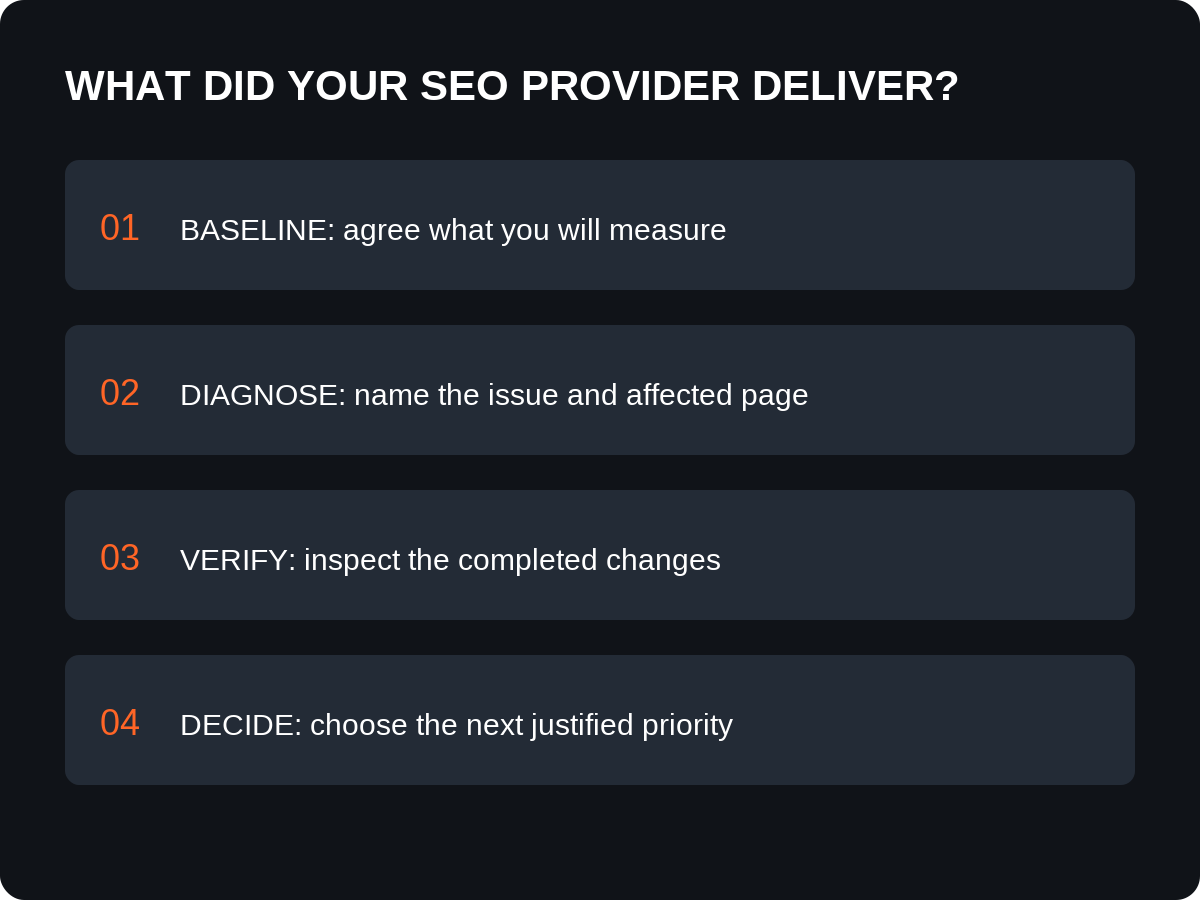
- Baseline: record the agreed pages, target market, reporting dates and available search and enquiry data. Mark missing measurement rather than replacing it with an estimate presented as fact.
- Diagnosis: request the affected URL or profile field, the observed problem, its likely business consequence and the proposed action. A generic audit score is not a sufficiently specific implementation brief.
- Delivery: list the actual edits, who approved them and where they are live. If development is excluded, identify the developer, dependency and expected next decision; a recommendation is not a completed repair.
- Validation: request evidence appropriate to each change. A repaired link should reach its intended page; a rewritten service page should contain approved facts; a form repair needs an authorised delivery test. Search indexing and rankings remain separate observations.
For example, a hypothetical commercial maintenance business in Thane might receive a recommendation to clarify its service area. A useful delivery record identifies the page, the approved coverage information, the actual change and the next check. Publishing several nearly identical location pages would not prove that customers now understand where the business works. This is a planning example, not a client case study.
How can you compare SEO proposals with different deliverables?
Compare the work required to solve the same business problem. Ask each provider to state whether its fee covers diagnosis, content production, implementation, verification and reporting. Do not compare an advice-only audit with a managed implementation package as though they provide the same service.
Request a written list of exclusions: developer time, new photography, landing-page development, reporting setup and third-party subscriptions may need separate agreement. Avoid assuming that any of these are included merely because the proposal says “complete SEO”. Ask who approves extra work and how the scope changes if the initial diagnosis finds a more urgent problem.
For an India-based company targeting US buyers, include the actual services, project fit and delivery arrangements in the brief. Ask how the proposed pages will answer those buyers' questions without inventing an American office or unsupported customer evidence. Local familiarity with Thane and research for an international buying journey are different parts of the scope.
When should you continue, revise or pause the SEO scope?
Continue when the agreed work is completed and checked, remaining dependencies are clear and the next priority follows from evidence. Revise the scope when a finding changes the order of work, such as a broken enquiry route taking priority over another article. Pause expansion when nobody can explain what was implemented, provide business access or distinguish observed results from estimates.
A quiet first month is not automatically failure, and a ranking increase is not automatically commercial success. Use the review to ask what is known, what is uncertain and what decision the evidence supports. Google's SEO hiring guidance recommends evaluating communication, relevant experience and measurement rather than accepting guaranteed first-place rankings.
Keep the next phase specific: the page to improve, the person responsible, the acceptance check and the review point. If the real issue is enquiries failing to become suitable opportunities, use our website enquiry diagnosis guide before commissioning more traffic-focused content.
Measure business enquiries alongside search visibility
Ask reports to distinguish completed work, search observations and commercial outcomes. Search Console impressions and clicks can help you understand discovery. Your enquiry records and sales team are needed to establish whether visitors became suitable prospects or customers.
Define a qualified enquiry in advance. For example, your team might require service fit, a relevant location and a realistic project requirement. A phone-button click alone does not establish any of these. Keep spam, duplicate enquiries and unsuitable requests identifiable.
Compare like periods and note changes in service capacity, offers or sales follow-up. If there is too little data to draw a conclusion, report that honestly. A rising technical score or an isolated AI citation should not be presented as proof of revenue.
Questions before signing
Must the agency be based in Thane? Local familiarity can help, but location alone does not establish capability. Check communication, market understanding, implementation support and relevant evidence.
Should SEO and Google Ads be in the same package? Only if the combined scope fits your goals. Ask for separate responsibilities and costs. The Google Ads management pricing guide explains how to separate advertising spend from service fees.
What if an agency sells GEO as well? Ask it to explain the specific work and measurement. Use the GEO agency buying guide to evaluate that additional scope.
Discuss a scope for your business
Review Diginfotech Solutions' SEO services, then Discuss Your Project. Share your website, priority service, target cities or countries and the kind of projects you want. That gives the discussion a concrete starting point: which pages need attention, who will do the work and how progress will be reviewed.
Enjoyed this article?
Add Diginfotech Solutions as a Preferred Source on Google to see more of our content in Search.