
Landing Page Design Services: What to Include Before You Hire
Compare landing page design services: copy, development, forms and pricing scope. Use practical delivery, measurement and launch tests before accepting the build.
Published on: 2026-10-02 by Shrikant Shenoy
Compare landing page proposals, then verify form delivery, measurement and handover with practical launch acceptance tests before you approve the work.
Landing page design services should turn a specific offer into a working customer journey: clear copy, a responsive page, a suitable enquiry form, reliable delivery of enquiries and agreed measurement. Before hiring a provider, ask exactly which of these are included. A design file alone is a different purchase from a launched page connected to your sales process.
Updated October 22, 2026: expanded launch acceptance tests, measurement verification and handover guidance. Originally published October 2, 2026.
This buyer guide is for service businesses in India and international markets that need a page for Google Ads, an organic search audience or a focused campaign. Use the scope worksheet below to compare proposals and the launch checklist to decide whether the work is ready to accept.
What should landing page design services include?
A useful proposal identifies the audience, offer, content responsibilities, design and development work, integrations, testing and handover. Some providers include all of these; others sell them separately. Request written deliverables so that attractive mockups do not conceal missing implementation work.
| Work area | Question for the provider | Evidence to request |
|---|---|---|
| Offer and copy | Who researches and writes the message? | Approved copy tied to the audience and service |
| Visual design | Are mobile layouts and revisions included? | Reviewed desktop and mobile designs |
| Development | Is this a working page or only a design file? | A deployed page on the agreed platform |
| Lead capture | Where do enquiries go, and who tests delivery? | A test record reaching the intended destination |
| Measurement | Which actions will be counted? | Documented events and a validation record |
| Handover | Who owns the assets and maintains the page? | Access, editable assets and support terms |
Landing page or full website: which do you need?
A landing page is a focused destination for a particular audience and action. A full website usually needs a broader structure for multiple services, company information and ongoing content. Choose based on what visitors must understand before contacting you, rather than the number of pages a package advertises.
A hypothetical Thane installation business promoting one commercial service might need a focused page explaining coverage, project suitability and how to request a site discussion. An international consultancy selling several different services may need stronger service pages first. These are planning examples, not client results.
If your existing service page already answers the right questions and works well, ask whether improving it would be more useful than creating another URL. If you need a campaign-specific version, agree how it relates to the main service page so visitors and the team know which offer is current.
Match the page to the reason someone visited
For Google Ads, check the connection between the search, advertisement and page. Google recommends matching the landing page to the ad and keywords, reflecting the advertised action and providing useful original information. It also recommends easy navigation and a usable mobile experience. Source: Google Ads landing-page guidance.
For example, an ad offering a commercial website redesign should not send visitors to a page that mainly promotes a downloadable template. Put the relevant service, who it is for and the next step near the beginning. Explain any important qualification limits honestly: project type, service location, required inputs or exclusions.
For an organic search page, answer the buying question in enough detail to be useful without an advertisement supplying context. Include scope, implementation responsibilities and relevant evidence. Avoid making a second page with almost identical text just to target another spelling of the same phrase.
What changes the cost of a landing page?
The quote depends on the work involved. A page built inside an existing design system differs from custom design, original copy, new illustrations and several integrations. Ask for separate line items for strategy and copy, design, development, integration, testing, hosting or software, and ongoing changes.
The number of revisions, who supplies content, the approval process and responsibility for launch also affect the scope. A deadline that assumes approved copy on day one will slip if the business has not prepared it. Identify these dependencies before comparing delivery promises.
Do not compare a design-only price with a fully implemented project as if they are equivalent. Ask whether taxes, third-party subscriptions, translation, extra variants and post-launch maintenance are included. This guide does not state a market price or a Diginfotech price because a defensible estimate needs your actual requirements.
Build the form around qualification and follow-up
Choose the smallest set of fields that lets your team take a useful next step. A service enquiry might need a name, contact method, service requirement and target location. A complex project may need additional context, but every required field should have a reason. Explain what happens after submission without promising a response time your team cannot meet.
Test more than the success message. Confirm the enquiry reaches the intended inbox or CRM, the sales team can identify the requested service, and failed submissions show a clear recovery path. Check duplicate submissions, invalid inputs and mobile keyboard behavior. Use clearly labeled test records and keep them out of conversion reporting.
Keep button clicks, accepted form submissions and qualified enquiries separate. Clicking WhatsApp does not prove a conversation happened. A received enquiry does not establish budget, service fit or purchase intent. Agree who reviews lead quality and how that feedback will reach the person managing the page.
Can a landing page rank organically or appear in AI answers?
A page created for a campaign can also be useful to search visitors when it answers a distinct need and is available for indexing. However, publishing a page does not guarantee a ranking or citation. Decide whether the page is meant for public discovery before choosing indexing and canonical settings.
Google says the usual SEO practices apply to AI Overviews and AI Mode; supporting pages must be indexed and eligible for a search snippet. It does not require special AI markup for those features. These are Google-specific requirements, not a promise about every AI chat product. Source: Google Search Central.
For useful, attributable content, describe the offer plainly, show genuine evidence, make important details available as text and keep facts current. Use concise answers where a buyer has a precise question, followed by the conditions that matter. Do not add invented statistics or unverified customer stories to make a page look authoritative. Our GEO versus SEO guide explains how to prioritize the overlapping work.
How should you test a landing page before accepting delivery?
Agree on observable pass conditions, not just a visual approval. The following tests are recommended acceptance criteria for a service-enquiry page. Run them with clearly labelled test data and the business owner's agreement; do not send invented enquiries to an unprepared sales team.
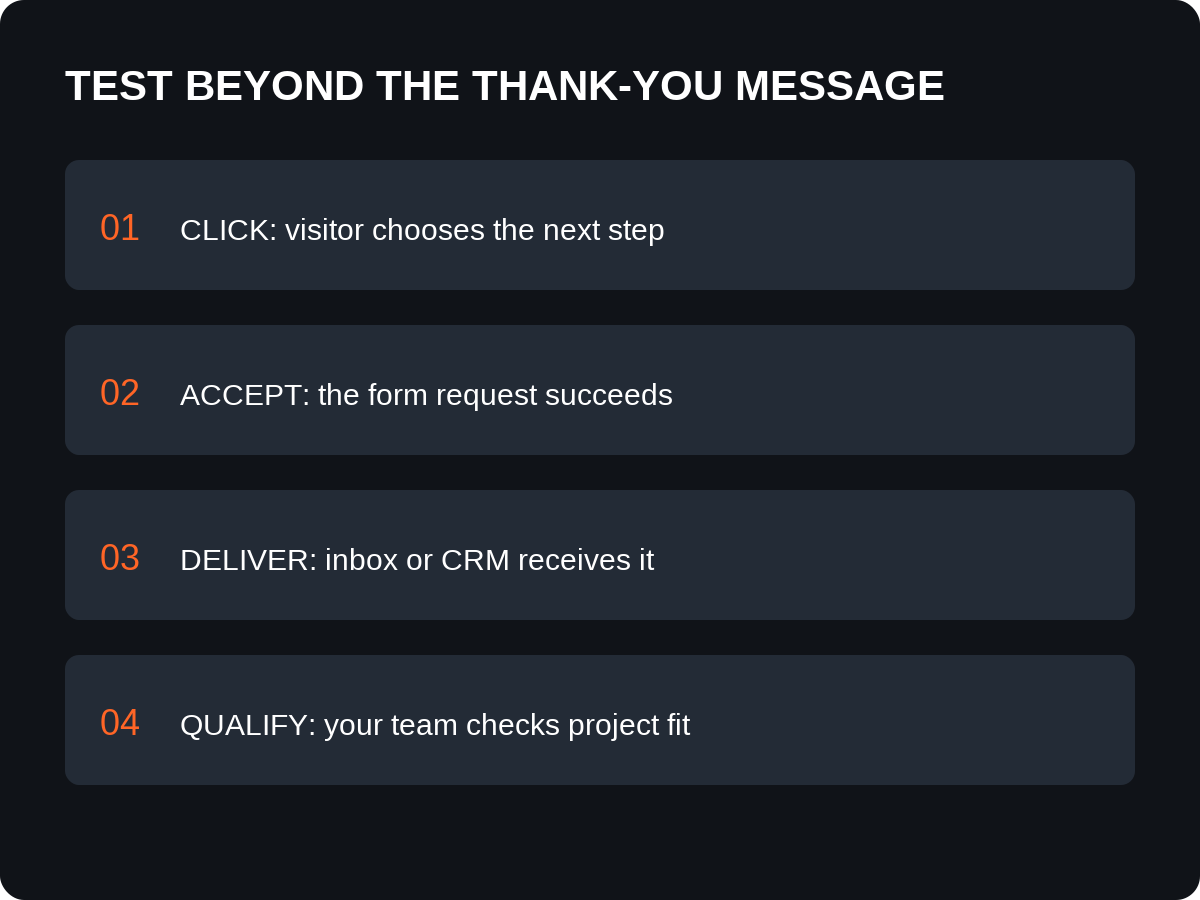
- Successful submission: send a unique test identifier through the form. Confirm the application accepts it and the intended inbox or CRM receives the correct service and contact details. A browser thank-you message alone is insufficient evidence.
- Invalid input: leave a required field empty or enter an invalid email format. The page should identify what needs correcting, retain other useful input and avoid showing a successful submission.
- Unavailable destination: in a controlled test environment, simulate the integration failing. Agree whether the application safely stores the enquiry for later delivery or reports the failure with a recovery option. It must not claim delivery that has not happened.
- Repeated action: test a double click and a retry after a slow response. Review whether duplicate records or duplicate success events appear. Document how the build prevents or reconciles them.
- Mobile and keyboard use: complete the journey on a phone and without a mouse. Labels, focus, validation messages and the submit control must remain usable; overlays should not hide the next step.
For each test, record the page version, date, expected result, actual result, evidence and person responsible for any correction. Use a test inbox or agreed CRM test stage, and remove or exclude test records from business reporting. Keep personal details out of screenshots shared for routine approval.
What proves that landing-page measurement is working?
Prove that the intended event reaches the intended measurement system and represents the action named in the brief. Google Analytics describes events as measurements of interactions or occurrences, and provides Realtime and DebugView for checking collection. Source: Google Analytics event guidance.
Ask the provider to demonstrate the distinction between clicking submit and successfully submitting. A failed request should not be counted as a completed enquiry. Check whether refreshing a thank-you page adds another event, and whether one form action triggers overlapping implementations. Document the agreed behavior instead of assuming a tag installation proves the whole journey works.
Measurement collection and enquiry delivery are separate tests. An event can arrive while an email fails, or a CRM record can arrive while measurement is unavailable. Consent choices and browser restrictions can also affect what is observable. Reconcile reporting with received records where possible and explain limitations; do not promise complete attribution.
What should be in the launch handover?
Request the live URL, editable assets, access responsibilities, integration details, acceptance results and a support owner. Agree how to restore the previous working version if a release breaks the enquiry journey. Confirm the intended title, canonical, indexing settings and internal links before campaign traffic starts.
Include performance evidence, with the device and test conditions stated. Google's Core Web Vitals cover loading, responsiveness and visual stability; they do not establish that a lead was delivered or that a visitor will purchase. Source: Google Search Central. Review a slower mobile journey as well as an attractive desktop screenshot.
For a hypothetical US campaign run by an India-based service provider, handover should also define who receives enquiries outside Indian office hours, what response expectation appears on the page and how opportunities are assigned. This is a planning example, not a customer result. Do not advertise a response commitment your team cannot meet.
If tracking and delivery pass but enquiries remain unsuitable, investigate offer fit and traffic intent before rebuilding the page. Our website lead-diagnosis guide provides a practical next step.
Questions to send with your request for a quote
Share your website, intended traffic source, priority service, target markets and the action you want visitors to take. Include the platform you use and where enquiries should arrive. Tell the provider which content and approved evidence you already have.
Then ask for a deliverables list, exclusions, dependencies, revision allowance, acceptance checks and post-launch responsibilities. For campaigns, coordinate the page brief with the ad manager; our Google Ads audit checklist covers the wider journey from tracking to lead quality.
Discuss your landing page scope
Explore our web development services and Google Ads management services, then Discuss Your Project. Send your website, offer, target market and enquiry destination so we can discuss the content, implementation and testing your project needs.
Enjoyed this article?
Add Diginfotech Solutions as a Preferred Source on Google to see more of our content in Search.